13/10/2026
Shanxi Jianlong Successfully Developed Ultra-Thick Paint Film Color Coated Steel Plate
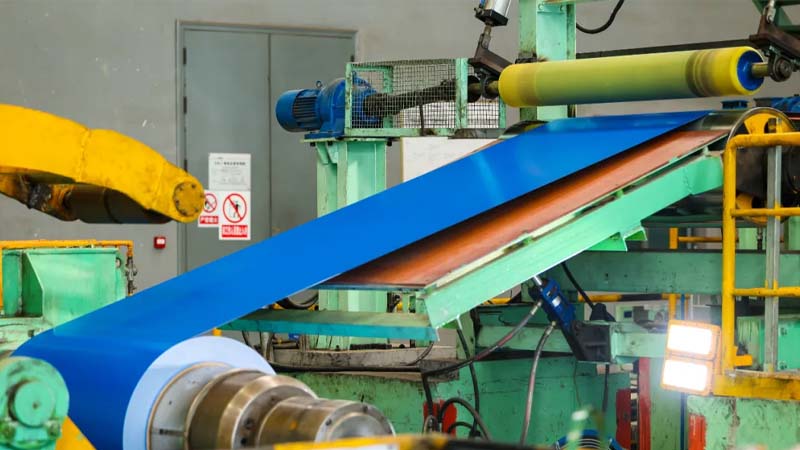
Recently, the 40μm thick fluorocarbon coated steel sheet with a front surface, developed and produced by Shanxi Jianlong's 1500mm color-coated steel sheet production line, has been successfully applied to the building envelope system of a key project.
Read More
05/03/2025
Shanxi Jianlong Successfully Developed Prepainted Steel Sheets for Steel Structure Buildings
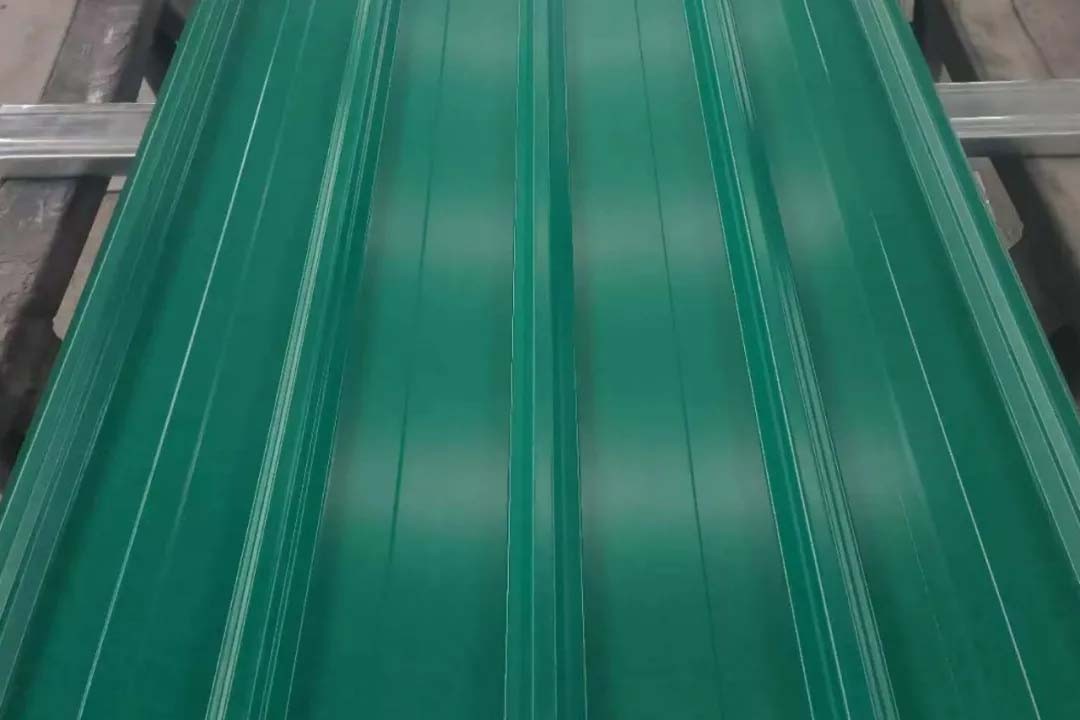
Recently, Shanxi Jianlong has successfully developed the structural grade prepainted steel sheet TS350GD+AZ.
1. Non-fixed length (standard/random length). This refers to product dimensions (length or width) that fall within the range specified by standards but do not require a specific, fixed size. Metal materials delivered under this classification need only fall within the prescribed length range. For example, for ordinary round steel with a diameter of 25mm or less, the standard length range is 4–10m; therefore, any round steel within this range is acceptable for delivery.
2. Fixed length. This refers to material cut to a specific, fixed dimension as required by the order. When delivered as fixed-length material, the metal must match the exact length specified by the buyer in the contract. For instance, if the contract specifies a fixed length of 5m, all delivered material must be exactly 5m long; lengths shorter or longer than 5m are considered non-compliant. However, since it is practically impossible for every piece to be exactly 5m, standards permit a positive deviation but prohibit any negative deviation.
3. Multiple length. This refers to material cut to an integer multiple of a fixed dimension specified in the order. When delivered as multiple-length material, the length must be an integer multiple of the base length (single length) specified by the buyer (plus the allowance for saw cuts). For example, if the buyer specifies a single length of 2m, a double length would be 4m and a triple length would be 6m, with the addition of one or two saw-cut allowances, respectively. Saw-cut allowances are defined in the standards. For multiple-length deliveries, only positive deviations are permitted; negative deviations are not allowed.
4. Short length. This refers to material with a length below the minimum limit of the standard non-fixed length range but above the absolute minimum permissible length. For example, standards for steel pipes used for water and gas transport allow a batch to contain up to 10% (by piece count) of short-length pipes measuring 2–4m. Here, 4m is the lower limit of the non-fixed length range, and 2m is the minimum permissible length.
5. Narrow width. "Narrow-width stock" refers to material with a width below the minimum specified for random-length/random-width stock but not less than the minimum permissible width. When supplying such material, one must adhere to the standards regarding the allowable proportion of narrow-width pieces and the absolute minimum width.
Fixed-length seamless steel pipes: "Fixed-length" refers to pipes delivered at specific lengths requested by the user. The purchaser specifies the exact length in the contract, and the manufacturer processes and cuts the seamless pipes to those dimensions. The advantages of fixed-length pipes include uniform length, which facilitates subsequent installation, fit-up, and welding while reducing the need for on-site cutting; they are ideal for projects with precise length requirements, such as pipeline prefabrication and structural support applications. Due to the precision processing and material loss involved, their price is typically slightly higher than that of random-length products.
Random-length (or variable-length) steel pipes: This term refers to pipes delivered within a standard length range rather than at a single, fixed value. Delivery is usually based on a specific length interval, with actual lengths varying within that range. Production of random-length pipes offers greater flexibility and higher material utilization rates, and they are generally more cost-effective; they are suitable for applications where length requirements are less strict and on-site cutting is feasible.
Purchasers can make a choice based on project needs: fixed-length pipes are preferable for projects requiring minimized on-site processing and high installation efficiency, whereas random-length pipes are more suitable for scenarios with flexible length requirements where cost control is a priority.
When purchasing piping materials or selecting them for engineering projects, it is easy to confuse seamless steel pipes with welded steel pipes. While they look similar and can both be used for applications such as fluid transport and steel structure construction, they possess fundamentally different core attributes.
The essential distinctions lie in their forming structures and manufacturing processes, which directly result in differences regarding their performance characteristics and suitable applications.
Structural formation is the primary difference between the two.
Seamless steel pipes are formed as a single, integral unit from solid billets through processes such as piercing, rolling, and drawing; the pipe body is free of any weld seams, resulting in superior structural integrity. In contrast, welded steel pipes are made from steel plates or strips that are rolled into shape and joined via welding; the presence of a fixed weld seam along the pipe body is a key visual distinguishing feature.
Differences in manufacturing processes lead to variations in performance.
Seamless pipes feature a uniform microstructure and balanced stress distribution, offering stable performance in terms of pressure resistance, sealing, and deformation resistance; they are suitable for demanding conditions involving high pressure, high temperatures, and corrosive environments. Welded steel pipes, produced using mature welding techniques, offer broad manufacturing versatility and reliable performance under standard operating conditions, making them suitable for routine applications such as general fluid transport and light structural framing.
Regarding selection and application, each type of pipe has its own ideal use cases.
Seamless steel pipes are typically chosen for high-standard applications, such as high-pressure oil and gas transport, precision machinery components, and the transport of high-temperature chemical media.
Welded steel pipes are suitable for general applications, such as standard water supply and drainage, civil infrastructure, and conventional steel structural supports, where they effectively meet basic material requirements.
The coating on anti-fingerprint sheet metal is primarily zinc; however, zinc-nickel alloy coatings are also found in actual products. In these cases, nickel is added as an alloying element rather than forming a pure nickel coating.
Anti-fingerprint sheet metal is essentially a composite material created by applying an anti-fingerprint film (an organic or inorganic coating) over a galvanized steel substrate (produced via either electro-galvanizing or hot-dip galvanizing). Therefore, the base coating is zinc.
Specifically, there are two main types of coatings:
Pure zinc coating (Z): This is the most traditional and common type. Continuous electro-galvanizing lines produce a coating composed of pure zinc, free from trace elements that could adversely affect painting performance.
Zinc-nickel alloy coating (ZN): This is a more advanced coating. Produced via electroplating, the coating consists of a zinc-nickel alloy containing approximately 8% to 15% nickel by weight, with the remainder being zinc.
China Steel Market
Empowering small and medium-scale steel purchasing
Hot search words:
China Rebar prices China Wire Rod Prices Welded Steel Pipe Prices